Credentialing & Privileging | 07.23.26
Practical AI Use Cases for Medical Services Professionals
By Geneva Million, CPCS, CPMSM
Artificial intelligence (AI) is safest when it supports administrative, rule-based, monitoring, and drafting work, but it becomes unsafe when it replaces human judgment, clinical context, or formal authority. AI can prepare and organize information, but people must still interpret, decide, approve, and remain accountable for the outcome.
Safe Uses of AI
- Auto-population
- Rules-based checks
- Routing and reminders
- Data sync and reporting
- Continuous monitoring
- Drafting and summarizing
Unsafe Uses of AI
- Any use that replaces human judgment, authority, or accountability
- Privilege decisions
- Clinical decision-making
- Approval decisions
- Predictive scoring when used as a decision-maker
- Using AI with sensitive data without approved safeguards
AI is a powerful tool, but it is still just that: a tool. As medical services professionals (MSPs), we must continue strengthening our critical thinking, communication, and cognitive reasoning skills. These are the skills that allow us to interpret information, manage nuance, and make sound recommendations.
In an industry that is chronically understaffed and lacks a clear entry pathway, many of us are overworked and juggling far too much. This is where AI can help. It can draft, refine, organize, and highlight areas that need attention, but decisions must remain with humans. ChatGPT cannot de-escalate an angry physician, and Claude cannot defend a recommendation in front of the Credentials Committee.
AI is already impacting our industry, but that impact does not have to be negative. Human expertise will always be essential in our profession.
Data Safety Reminder
Be cautious when using large language models (LLMs) such as ChatGPT, Claude, Gemini, or Copilot with sensitive or identifiable data. Check with your organization’s IT department about their approved tools. When possible, use an approved enterprise-licensed tool rather than a free public version.
Now that we know when and where AI is safe, let’s review some practical applications of AI tools.
Meeting Minutes
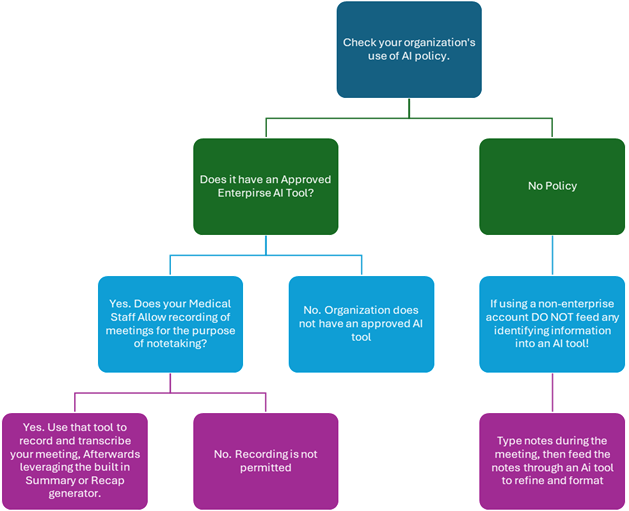
ALWAYS review the AI output for accuracy before
bringing to committee or filing minutes!
|
If your organization uses Microsoft Teams with Copilot or Zoom AI Companion, these tools can support meeting minute-taking. Use the “record and transcribe” tools available in these platforms, then generate a meeting summary or recap using the AI tool.
💡 Pro Tip: You do not have to stick with the standard note output. Microsoft Copilot, for example, allows for custom summary templates. You can create a custom meeting summary template in the format you need.

Once again, it is essential that meeting notes are reviewed by you before committee review or permanent filing. Even when AI accurately captures the substance of a meeting, it may misspell proper names, acronyms, or product names. Leaving those errors uncorrected quickly signals that the notes were not reviewed by a human. For example, in meetings where NPI verifications were mentioned, Copilot has often inserted MPI instead.
If your organization does not allow meeting recording or transcription, you can still enter your typed notes into an approved AI tool and ask it to help refine your notes. The tool can help organize points into defined sections, improve clarity, and identify action items when appropriate.
Sensitive Emails
Have you ever received an email from a provider or leader that immediately raised your stress level?
For example, a physician may demand that you credential and privilege nurses who are not advanced practice providers, or claim they were never notified about a deadline despite multiple reminders. It’s important to clearly communicate the appropriate boundary but to do it in a professional, constructive, and sensitive tone. Once you’ve written your first draft, select the content and ask your AI tool to help you rewrite it.

It is important to review the AI output and ensure it remains in your voice, but this exercise can help keep your communication professional while clearly expressing your point.
Privilege Comparison
Although hospitals should regularly review delineation of privilege forms to ensure they remain current and accurate, many organizations struggle to keep up with these reviews. AI can help with the first round of analysis.
Privilege form updates can be a monumental task. The process often includes reviewing external examples, comparing them against existing forms, checking current specialty association guidance, and moving proposed updates through committee review.
You could search for and download publicly accessible privilege forms across several organizations and compare privileges and criteria across each template manually, or you could use your preferred AI tool to assist with the initial analysis. If using Copilot, open your delineation of privileges template in Word; otherwise, upload the template to your approved AI tool.

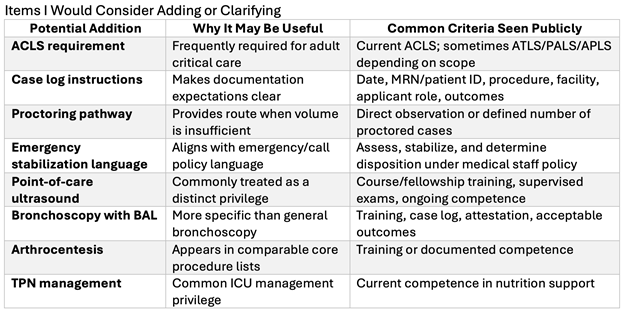
Below is an example of what that output might look like for a critical care privilege form. Along with a summary of suggested updates, the tool generated a comparison grid of missing or unclear items for review.
Sample AI output:
Standardizing Privilege Forms Across Facilities in a Health System
Across the country, health systems are increasingly focused on centralization and standardization. When it comes to privileges, this is especially important because misaligned criteria across facilities in the same system can expose each facility to liability. On the surface, this may seem easier than writing a new privilege form because your organization already has templates to start from. However, internal centralization can be even more complicated. Where do you start? How do you compare forms across multiple facilities when they vary by age, criteria, and supported privileges?
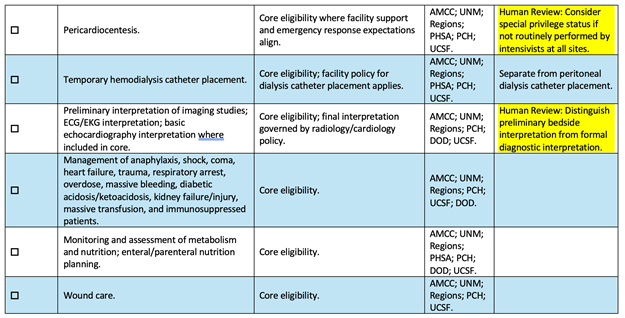
While this work can be done manually, the process is often lengthy and cumbersome. With daily operational demands, projects like these are often deprioritized and delayed. Consider using an approved AI tool to help with the first round of analysis. This will not remove humans from the decision-making process, but it can help you and your leadership focus on the most important questions.
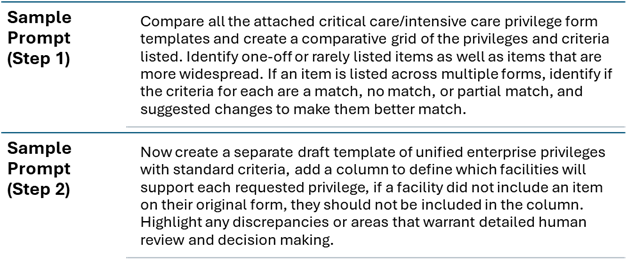
Upload all facility forms for a single aligned specialty or service line into your approved AI tool and ask it to help compare them. Use a consistent prompt format, such as the sample prompt below.
Sample AI output:
Policy and Bylaws Comparisons
Standards change all the time. Are your bylaws, rules, and regulations keeping up? Some organizations review these documents annually, while others have not done so in a decade. Either way, bylaws are typically lengthy, and a full line-by-line analysis may not be feasible. As more organizations centralize and standardize, bylaws may also need to be assessed for consolidation into a single enterprise template.
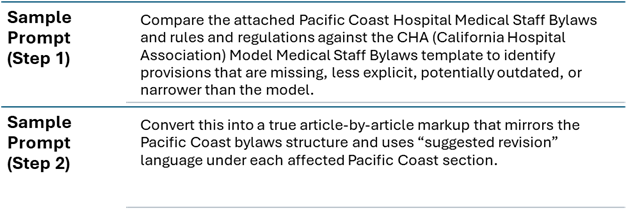
Sample AI output:
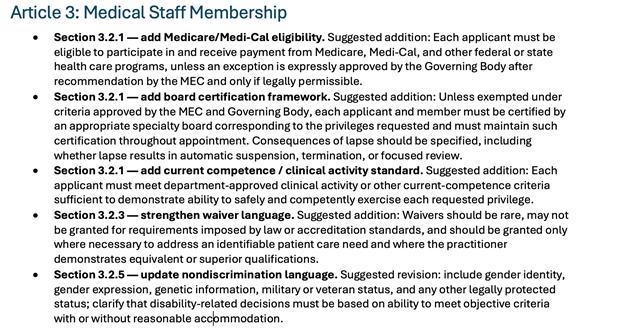
Conclusion
AI will continue to influence the way MSPs work, but its value is not in replacing expertise. Its value is in helping us manage the growing volume of information, identify what needs attention, and create more time for the judgment-based work only humans can do. When used thoughtfully, AI can help us draft more clearly, compare documents more efficiently, organize complex information, and focus more of our energy on the conversations, recommendations, and decisions that protect patients and support our organizations.
For MSPs, this is an opportunity to level up. Our expertise is irreplaceable, and by allowing AI to assist where appropriate, we can shift our focus from task management to professional advising. By learning how to use approved AI tools safely, asking better questions, reviewing outputs carefully, and keeping accountability where it belongs, we can strengthen our workflows without weakening our professional standards. AI may help us move faster, but our experience, discernment, and commitment to patient safety must continue to lead the way.

Geneva Million, CPCS, CPMSM
Geneva Million is a seasoned medical staff services leader with more than 15 years of experience in credentialing, privileging, and compliance. She holds dual certification as a CPCS and CPMSM and has built her career around improving efficiency, compliance, and collaboration in healthcare operations.
As principal customer success manager at Applied Statistics & Management, Inc. (DBA MD-Staff), Geneva partners with hospitals and health systems across the country to implement data-driven credentialing solutions, streamline workflows, and enhance provider experiences. She is widely recognized for her ability to bridge the gap between technology and operations, turning complex requirements into sustainable, practical processes.
A frequent speaker at national conferences, Geneva is known for her engaging presentation style and her passion for advancing the role of medical staff professionals. She is dedicated to empowering teams, mentoring future leaders, and driving innovation that supports both providers and patients.