Credentialing & Privileging | 05.12.26
Demystifying Artificial Intelligence: What AI Really Is (and What It Isn’t)
By Geneva Million, CPCS, CPMSM
When most people hear the term artificial intelligence (AI), they immediately think of tools like ChatGPT, Google Gemini, or Microsoft Copilot. While these tools are impressive and often transformative, they represent only a small slice of the broader AI landscape. To truly understand AI, we need to zoom out, strip away the hype, and look at how this technology has evolved and how it actually works.
Understanding the AI Landscape
At its most basic level, AI is any technology that enables a machine to perform a human‑like task. This definition is far broader than most people expect. Something as simple as a robot vacuum navigating a living room is technically AI — it senses its environment, makes decisions, and acts without human intervention.
To help clarify this, it’s useful to think of AI as a hierarchy, with increasingly sophisticated capabilities as you move inward:
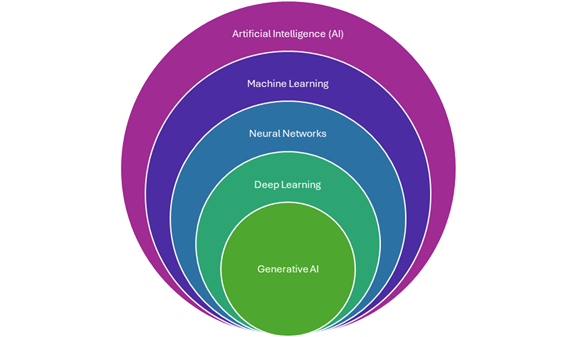
Understanding the Hierarchy
Artificial Intelligence (AI)
This is the outermost ring. AI includes any automation that mimics human behavior, from basic decision trees to advanced autonomous systems. Many AI systems operate quietly in the background, embedded into everyday tools we rarely think twice about.
Machine Learning (ML)
Machine learning is a subset of AI defined by algorithms that allow machines to learn from examples rather than explicit instructions. A common example is image classification, where systems are trained on labeled images and learn to recognize patterns that allow them to correctly categorize new images.
Neural Networks
Neural networks take machine learning a step further. Inspired by the human brain, they use interconnected layers of nodes to detect complex patterns. Familiar examples include Netflix recommendations and email spam filters, both of which learn from user behavior over time to improve their predictions.
Deep Learning
Deep learning builds on neural networks by using multiple layers (deep neural networks) to process increasingly abstract features. Facial recognition is a powerful example. These systems can adapt as people age or their appearance changes, learning continuously rather than relying on static rules.
Generative AI
Finally, we arrive at generative AI, the layer that currently dominates headlines. Generative AI systems, such as large language models (LLMs), don’t just analyze data; they create new content, including text, images, and code. While highly visible, generative AI is only one part of a much larger AI ecosystem.
AI: Decades in the Making
Despite the sense that AI has “suddenly appeared,” its roots stretch back more than 70 years. Viewing AI through a historical lens reveals a steady progression rather than an overnight breakthrough.
AI has evolved steadily over more than seven decades, beginning in the 1940s–1950s with foundational ideas such as Alan Turing’s “Turing Test” and the formal naming of AI at the 1956 Dartmouth Conference. In the 1960s–1970s, early rule‑based systems showed that computers could support human decision making in narrow domains. Progress continued through the 1980s–1990s with knowledge‑based systems and clinical decision support, highlighted by IBM Deep Blue’s 1997 chess victory, which marked a shift toward probabilistic reasoning. The 2000s–2010s saw rapid advancement driven by electronic health records and large datasets, enabling machine learning and deep learning breakthroughs in imaging, genomics, and drug discovery. Today, in the 2020s, AI includes autonomous diagnostic tools, predictive analytics, and generative AI, which increasingly act as collaborative partners in documentation, communication, and data analysis, alongside growing ethical and regulatory oversight.
AI Tools in the MSO
|
|
Rule-Based AI
(Deterministic, “If–Then” Systems)
|
Probabilistic AI
(Machine Learning and Predictive Models)
|
Generative AI
(Large Language Models and Content Creation)
|
|
What It Is
|
- Operates on explicit rules defined by humans
- Produces the same outcome every time for the same input
- Does not learn or adapt unless rules are manually updated
|
- Learns from historical data
- Produces likelihoods, trends, or risk indicators
- Improves as more data becomes available
|
- A subset of probabilistic AI designed to generate new content
- Uses natural language as the interface
- Produces drafts, summaries, explanations, and narratives
|
|
How It Thinks
|
If X condition is met, then perform Y action.
|
Based on past patterns, this outcome is more or less likely.
|
Given this context, what is the most likely next word or response?
|
|
Common Medical Staff Applications
|
- Credentialing systems that:
- Flag incomplete applications
- Auto-run verifications and alerts of expiring items
- Prevent applications from advancing when potentially negative items are present
- Automated enforcement of:
- Bylaws, policies, and privileging criteria
- Reappointment timelines and notice requirements
- Compliance checks tied to:
- Regulatory thresholds
- Mandatory attestations or acknowledgments
|
- Peer review support:
- Identifying patterns across cases rather than isolated events
- Highlighting providers or service lines with emerging trends
- Quality and performance analytics:
- Detecting outliers in outcomes or utilization
- Supporting fair and consistent review thresholds
- Operational insight:
- Forecasting credentialing or reappointment workload
- Identifying bottlenecks in MSO processes
|
- Credentialing and governance support:
- Summarizing tasks or verifications for MSP review
- Drafting committee agendas or meeting minutes
- Communication:
- Drafting provider notifications
- Creating standardized response templates for MSP use
- Documentation and education:
- Explaining bylaws or policies in plain language
- Summarizing regulatory updates for internal distribution
|
|
Where It Excels
|
- Regulatory compliance
- Auditability and transparency
- High‑stakes, rules‑driven workflows
|
- Pattern recognition across large datasets
- Early visibility into potential risks or trends
- Supporting proactive governance
|
- Significant time savings
- Reduces documentation burden
- Improves consistency in written communication
|
|
Where It Falls Short
|
- Cannot handle nuance, exceptions, or gray areas
- No ability to detect patterns or improve over time
|
- Outputs are not decisions
- Can be difficult to fully explain
- Requires strong data quality and oversight
|
- Can sound confident while being incorrect
- Not a source of truth
- Requires human review, validation, and approval
- Must not be used for autonomous decisions
|
|
Summary
|
Rule‑based AI enforces rules and protects compliance.
|
Probabilistic AI surfaces trends and risk signals.
|
Generative AI accelerates communication and documentation.
|
Understanding Large Language Models (LLMs)
Large language models are a subset of generative AI focused on natural language processing. They are trained on vast datasets to learn the structure and patterns of language, enabling them to perform tasks such as summarization, translation, and question answering.
What’s truly new is not the idea of AI itself, but the combination of natural language interfaces and the speed at which these models are improving. LLMs can be open‑source or proprietary, each with different approaches to training data, privacy controls, and compliance considerations. Understanding these differences is critical, especially in regulated industries like healthcare and credentialing, where confidentiality and ethical use are paramount.
Moving Past the Hype
Demystifying AI means recognizing two truths at the same time:
- AI is not magic: It is the result of decades of incremental progress, data, and engineering.
- AI is powerful: Especially when thoughtfully integrated into workflows to augment, not replace, human expertise.
By understanding where AI fits within a broader technological continuum, organizations and individuals alike can move beyond fear or fascination and toward informed, responsible adoption.
For MSPs, the safest and most effective use of AI is augmentation: AI prepares, flags, summarizes, and organizes. MSPs decide, interpret, and govern.
References

Geneva Million, CPCS, CPMSM
Geneva Million is a seasoned medical staff services leader with more than 15 years of experience in credentialing, privileging, and compliance. She holds dual certification as a CPCS and CPMSM and has built her career around improving efficiency, compliance, and collaboration in healthcare operations.
As principal customer success manager at Applied Statistics & Management, Inc. (DBA MD-Staff), Geneva partners with hospitals and health systems across the country to implement data-driven credentialing solutions, streamline workflows, and enhance provider experiences. She is widely recognized for her ability to bridge the gap between technology and operations, turning complex requirements into sustainable, practical processes.
A frequent speaker at national conferences, Geneva is known for her engaging presentation style and her passion for advancing the role of medical staff professionals. She is dedicated to empowering teams, mentoring future leaders, and driving innovation that supports both providers and patients.